 IT Academy Pro Team

From CCNA to CCNP: Your Networking Career Roadmap
Introduction
Networking is one of the most important foundations of modern IT infrastructure. Every organization depends on reliable networks to connect employees, applications, servers, cloud platforms, and business systems. As businesses continue to expand their digital operations, skilled network professionals remain essential for building, managing, securing, and troubleshooting network infrastructure.
For aspiring network engineers, Cisco certifications provide a structured way to develop networking knowledge and demonstrate technical skills. Two of the most recognized certifications in this journey are the Cisco Certified Network Associate (CCNA) and the Cisco Certified Network Professional (CCNP).
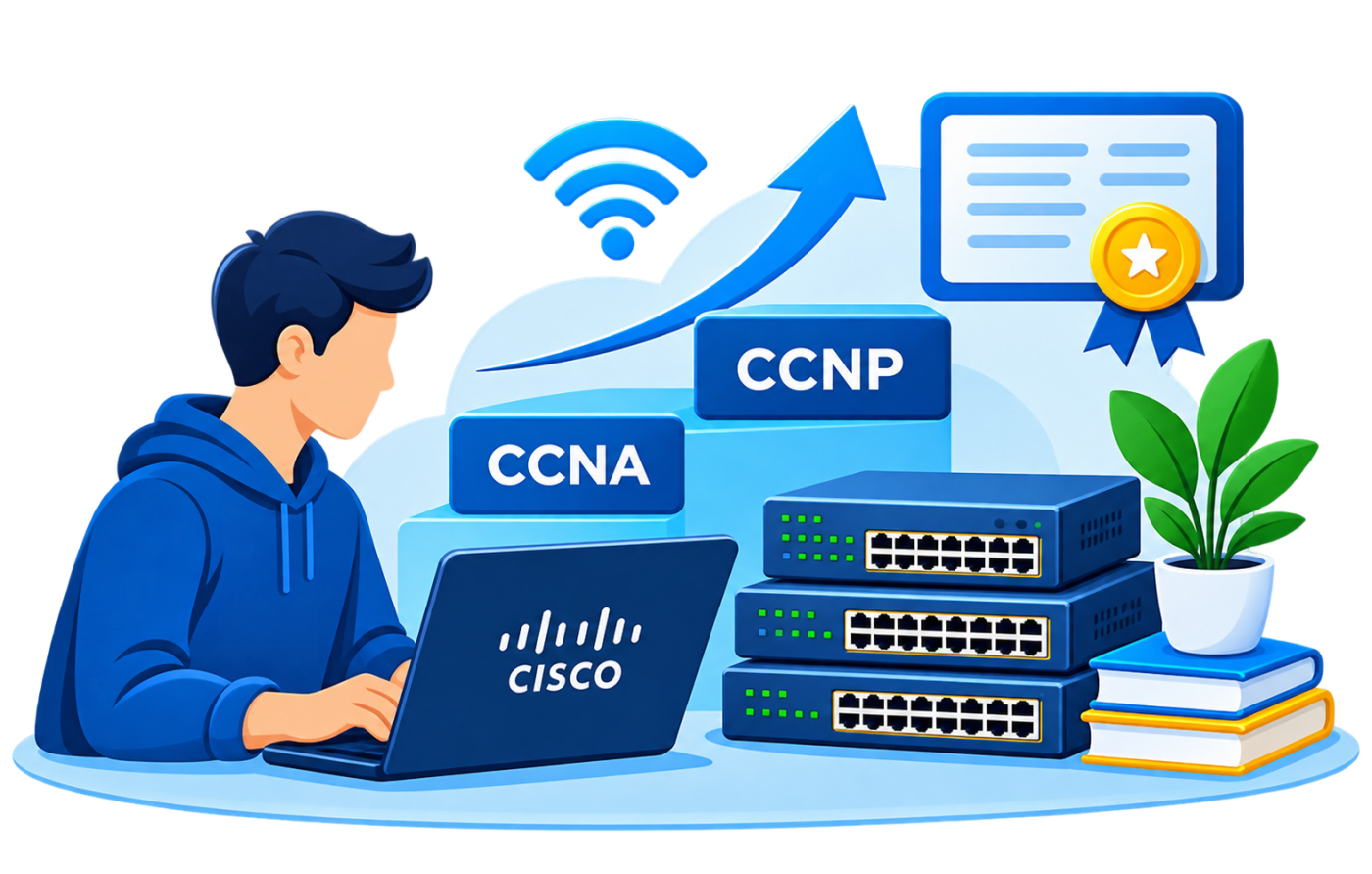
The CCNA certification helps learners build a strong foundation in networking, while CCNP takes those skills further into advanced routing, enterprise infrastructure, network security, automation, and troubleshooting.
But how do you move from CCNA to CCNP? What skills should you develop? Which exams should you take? And what career opportunities can you pursue along the way?
This guide explains the complete networking career roadmap, from learning the fundamentals to becoming a professional network engineer.
1. Understanding the CCNA and CCNP Certifications
Before planning your networking career, it is important to understand the difference between CCNA and CCNP.
What is CCNA?
The Cisco Certified Network Associate (CCNA) is an associate-level certification designed to validate essential networking knowledge and skills.
It helps learners understand how networks operate, how devices communicate, and how to configure and troubleshoot basic network infrastructure.
The CCNA certification covers:
- Network fundamentals
- Network access
- IP connectivity
- IP services
- Security fundamentals
- Automation and programmability
The CCNA exam is 200-301 CCNA, officially known as Implementing and Administering Cisco Solutions.
It is a suitable starting point for aspiring network technicians, network administrators, IT support professionals, and junior network engineers.
What is CCNP?
The Cisco Certified Network Professional (CCNP) is a professional-level certification designed for individuals who want to develop advanced networking expertise.
CCNP focuses on implementing, operating, troubleshooting, and managing more complex network environments.
For professionals interested in enterprise networking, CCNP Enterprise is a popular certification pathway.
Its technical areas include:
- Advanced routing and switching
- Enterprise network architecture
- Network virtualization
- Infrastructure security
- Network assurance
- Quality of Service (QoS)
- Network automation and programmability
The CCNP Enterprise certification requires passing a core exam and one concentration exam of your choice.
Unlike CCNA, CCNP does not require CCNA certification as a formal prerequisite. However, having CCNA-level knowledge is strongly recommended before attempting professional-level exams.
2. The Networking Career Roadmap: From CCNA to CCNP
Building a successful networking career requires more than passing certification exams. You need to develop practical skills, understand real network environments, and gain experience troubleshooting technical problems.
The following roadmap provides a structured progression.
Stage 1: Build Your Networking Foundation
Before pursuing CCNA, start by learning the fundamentals of computer networking.
Understanding the basic concepts will make advanced topics easier to learn.
Important topics include:
- What is a computer network?
- LAN, WAN, WLAN, and MAN
- OSI and TCP/IP models
- IPv4 and IPv6 addressing
- Subnetting and CIDR
- Ethernet and MAC addresses
- TCP and UDP
- DNS, DHCP, and ARP
- Routers, switches, and firewalls
You should also become comfortable using basic networking commands such as:
ping
tracert or traceroute
ipconfig or ifconfig
nslookup
show ip interface brief
These commands help you understand connectivity, IP configuration, and basic troubleshooting.
Career objective: Develop the foundational knowledge required for entry-level networking roles.
Stage 2: Earn Your CCNA Certification
Once you understand networking fundamentals, begin preparing for the CCNA certification.
The CCNA provides a structured learning path covering the core technologies used in enterprise networks.
During your preparation, focus on understanding how networking technologies work rather than simply memorizing exam answers.
Key CCNA skills
Network access: Learn VLANs, trunking, EtherChannel, spanning-tree concepts, and wireless fundamentals.
IP connectivity: Understand routing tables, static routing, OSPF, and first-hop redundancy concepts.
IP services: Learn DHCP, DNS, NAT, NTP, and network management.
Security fundamentals: Understand access control lists, device hardening, authentication, and basic security practices.
Automation: Explore network programmability, APIs, and basic Python concepts.
Practical CCNA lab exercises
Try completing these tasks in Cisco Packet Tracer, Cisco Modeling Labs, or another suitable network simulator:
- Configure a router and switch.
- Create VLANs and configure trunk links.
- Configure inter-VLAN routing.
- Configure static routes between networks.
- Implement OSPF in a small network.
- Configure DHCP and NAT.
- Troubleshoot connectivity problems.
- Secure device management using SSH.
Hands-on practice is essential because it helps you understand how network devices behave in real situations.
Career objective: Become ready for entry-level networking jobs and develop the foundation needed for CCNP.
Stage 3: Gain Real-World Networking Experience
After developing your CCNA skills, begin applying for networking-related roles.
Practical experience is one of the most valuable parts of a networking career. Working with real infrastructure helps you understand how organizations maintain network availability, manage incidents, and troubleshoot complex issues.
Possible entry-level positions include:
- Network Support Engineer
- Network Technician
- IT Support Engineer
- Junior Network Administrator
- NOC Engineer
- Junior Network Engineer
In these roles, you may work on network monitoring, troubleshooting connectivity issues, configuring access switches, documenting network changes, and escalating incidents.
What should you learn on the job?
Focus on developing practical skills in:
- Troubleshooting network connectivity
- Monitoring network performance
- Managing Cisco routers and switches
- Understanding VLANs and routing
- Working with network diagrams
- Analyzing logs and network alerts
- Documenting incidents and changes
- Understanding network security controls
For example, imagine a user reports that they cannot access a company application.
A network engineer should investigate whether the issue is caused by IP addressing, DNS resolution, routing, VLAN configuration, firewall rules, or an application-related problem.
This type of structured troubleshooting is what transforms theoretical knowledge into professional networking skills.
Career objective: Build the practical experience required to handle enterprise network environments.
Stage 4: Start Preparing for CCNP Enterprise
Once you have developed CCNA-level knowledge and gained practical networking experience, you can begin preparing for CCNP Enterprise.
CCNP preparation requires a deeper understanding of networking technologies. You should be comfortable configuring routers and switches, analyzing routing behavior, and troubleshooting multi-device network environments.
The certification consists of two exams:
| Exam | Code | Focus |
|---|---|---|
| Core | 350-401 ENCOR | Enterprise network technologies |
| Concentration | 300-410 ENARSI or another approved option | Specialized enterprise networking skills |
The ENCOR exam covers enterprise infrastructure, dual-stack architecture, virtualization, network assurance, security, and automation.
For professionals interested in advanced routing and troubleshooting, ENARSI is a common concentration choice.
Other concentration options allow you to specialize in SD-WAN, enterprise design, automation, cloud connectivity, or network assurance.
The right concentration depends on your career goals.
Stage 5: Master Advanced Networking Technologies
CCNP preparation is an opportunity to develop the advanced skills required to manage enterprise infrastructure.
Advanced routing
Learn how routing protocols operate in larger networks.
Important topics include:
- OSPF optimization and troubleshooting
- EIGRP concepts
- BGP fundamentals and implementation
- Route redistribution
- Routing policies
- IPv4 and IPv6 troubleshooting
Enterprise switching
Develop a deeper understanding of switching technologies.
Focus on:
- Layer 2 and Layer 3 switching
- Spanning Tree Protocol
- EtherChannel
- VLAN design
- First-hop redundancy
- Campus network architecture
Network security
Understand how to protect enterprise network infrastructure.
Learn about:
- Infrastructure access control
- Access control lists
- Secure management protocols
- Network segmentation
- VPN technologies
- Network security monitoring
Network automation
Modern networking increasingly relies on automation and programmability.
Develop an understanding of:
- Python fundamentals
- REST APIs
- JSON and YAML
- Network configuration automation
- Ansible fundamentals
- Cisco network controllers
Automation can help network professionals reduce repetitive tasks, improve configuration consistency, and manage larger infrastructures more efficiently.
Stage 6: Complete Advanced Network Engineering Projects
Practical projects are an excellent way to demonstrate your skills to employers.
Instead of only studying individual technologies, build complete network environments that combine multiple concepts.
Here are some projects you can complete during your CCNP preparation.
Project 1: Enterprise Campus Network
Design a network for a company with multiple departments.
Include:
- Multiple VLANs
- Layer 3 switching
- Inter-VLAN routing
- OSPF
- Redundant links
- Access control lists
- DHCP services
The objective is to create a reliable network that supports communication between departments while maintaining appropriate security controls.
Project 2: Multi-Site Enterprise Network
Design a network connecting a company's headquarters and branch offices.
Include:
- Multiple routers
- WAN connectivity
- OSPF or BGP
- Route redistribution where appropriate
- VPN connectivity
- Redundant routing paths
Test what happens when a WAN connection fails and verify that traffic can use an alternative path.
Project 3: Network Troubleshooting Lab
Create a network containing several configuration errors.
Examples include:
- Incorrect VLAN assignments
- Missing trunk configuration
- Incorrect IP addressing
- OSPF neighbor issues
- Incorrect routing statements
- Access control list mistakes
- DHCP configuration problems
Your task is to identify the root cause, resolve the issue, and document the solution.
This project is especially valuable because troubleshooting is a major part of professional network engineering.
Project 4: Network Automation
Create a basic automation workflow using Python.
For example, build a script that collects device information, checks network connectivity, or retrieves interface status from network devices.
Start with simple tasks and gradually introduce APIs and automation frameworks.
These projects can become part of your networking portfolio and help demonstrate your practical abilities.
3. CCNA vs. CCNP: What Is the Difference?
Understanding the difference between these certifications can help you decide when to progress to the next level.
| Feature | CCNA | CCNP Enterprise |
|---|---|---|
| Certification level | Associate | Professional |
| Main focus | Networking fundamentals | Advanced enterprise networking |
| Exam requirement | One core exam | One core + one concentration |
| Routing knowledge | Foundational | Advanced |
| Troubleshooting | Basic to intermediate | Advanced |
| Automation | Introduction | More advanced concepts |
| Career direction | Junior networking roles | Professional network engineering roles |
The CCNA helps establish your networking foundation, while CCNP helps you demonstrate more advanced technical capabilities.
Both certifications can be valuable depending on your current experience and career objectives.
4. Career Opportunities After CCNA and CCNP
Cisco certifications can support your career development, but job opportunities also depend on your practical experience, communication skills, technical knowledge, and local job market.
Career opportunities after CCNA
CCNA can help prepare you for roles such as:
- Network Support Engineer
- Network Technician
- IT Support Engineer
- Junior Network Administrator
- NOC Engineer
- Junior Network Engineer
These positions often involve monitoring networks, resolving connectivity issues, configuring basic infrastructure, and supporting network operations.
Career opportunities after CCNP
With advanced networking knowledge and relevant experience, you may pursue roles such as:
- Network Engineer
- Senior Network Engineer
- Network Infrastructure Engineer
- Enterprise Network Engineer
- Network Operations Engineer
- Network Consultant
- Network Design Engineer
Experienced professionals may also progress toward network architecture, technical leadership, or infrastructure management.
Remember that CCNP certification alone does not guarantee a senior-level position. Employers typically look for a combination of certification, experience, troubleshooting ability, and practical knowledge.
5. How Long Does It Take to Go From CCNA to CCNP?
The time required depends on your existing knowledge, study schedule, practical experience, and exam readiness.
The following is an illustrative study plan rather than a guaranteed timeline.
| Stage | Estimated duration |
|---|---|
| Networking fundamentals | 1–2 months |
| CCNA preparation | 3–5 months |
| Practical networking experience | 6–12 months or more |
| CCNP ENCOR preparation | 3–5 months |
| CCNP concentration preparation | 2–4 months |
Some learners may progress faster, while others may need additional time to develop practical skills.
A consistent study routine is more important than rushing through the certification pathway.
For example, studying for 1–2 hours each day and completing regular hands-on labs can help you build a strong understanding of networking technologies.
6. Best Study Resources for CCNA and CCNP
Choosing the right learning resources can make your certification journey more organized and effective.
Cisco official learning resources
Cisco provides official certification guides, training programs, and learning paths.
These resources help learners understand the exam objectives and prepare for certification.
Explore:
Network simulation tools
Hands-on labs are essential for developing practical networking skills.
Popular tools include:
- Cisco Packet Tracer
- Cisco Modeling Labs
- GNS3
- EVE-NG
Packet Tracer is a useful starting point for CCNA-level practice. More advanced simulation and emulation environments can help learners develop CCNP-level troubleshooting and configuration skills.
Online networking courses
Structured online courses can help learners follow a planned curriculum, understand difficult concepts, and practice exam-related topics.
IT Academy Pro provides an online learning environment where learners can explore IT certification training and develop their technical knowledge.
Explore the available networking learning paths at <Link url="https://lms.itacademypro.com/" title="IT Academy Pro LMS"/>.
7. Common Mistakes to Avoid When Moving From CCNA to CCNP
Many learners struggle when progressing from associate-level to professional-level networking.
Avoid these common mistakes.
Memorizing answers instead of understanding concepts
Memorizing exam questions may help with short-term recall, but it does not develop the skills needed to configure and troubleshoot real networks.
Focus on understanding why a technology works and how it behaves under different conditions.
Skipping hands-on practice
Networking is a practical discipline.
Reading about OSPF or BGP is not enough. You should configure these technologies, observe their behavior, and troubleshoot problems.
Ignoring troubleshooting skills
Professional network engineers need to identify root causes rather than simply apply configuration commands.
Practice analyzing routing tables, interface states, logs, packet captures, and network diagrams.
Rushing into CCNP without a strong foundation
CCNP topics build upon many concepts introduced at the CCNA level.
If subnetting, VLANs, routing fundamentals, or basic network troubleshooting are still difficult, spend more time strengthening those areas.
Focusing only on certification exams
Certifications can demonstrate knowledge, but employers also value practical experience.
Build projects, document your labs, and gain experience working with real infrastructure whenever possible.
8. Your Networking Career Roadmap at a Glance
The following progression can help you organize your learning and career goals.
Step 1: Learn networking fundamentals.
Step 2: Prepare for and earn CCNA.
Step 3: Build hands-on networking projects.
Step 4: Apply for entry-level networking roles.
Step 5: Gain practical experience with enterprise infrastructure.
Step 6: Prepare for CCNP Enterprise ENCOR.
Step 7: Choose a concentration aligned with your career goals.
Step 8: Complete advanced networking projects.
Step 9: Develop skills in automation, security, and network design.
Step 10: Pursue professional network engineering opportunities.
This roadmap provides a structured way to progress from foundational networking knowledge to advanced enterprise networking skills.
Conclusion
Moving from CCNA to CCNP is an important step in developing a professional networking career.
The CCNA certification provides the foundation required to understand network infrastructure, while CCNP Enterprise helps learners develop more advanced skills in routing, switching, network security, automation, and enterprise network operations.
However, certification should be only one part of your career development.
Practical experience, hands-on labs, troubleshooting exercises, and real-world projects are equally important. They help you understand how networks operate and prepare you to solve the technical challenges organizations face every day.
Whether you are starting your networking journey or already working as a junior network engineer, a structured learning plan can help you build the skills needed to progress.
Start with the fundamentals, strengthen your CCNA knowledge, gain practical experience, and gradually move toward CCNP-level expertise.
Your networking career is a journey of continuous learning. With the right preparation, consistent practice, and dedication, you can build a strong foundation for a successful career in network engineering.
Frequently Asked Questions (FAQs)
1. Can I go directly from CCNA to CCNP?
Yes. Cisco does not require CCNA certification as a formal prerequisite for CCNP Enterprise. However, CCNA-level knowledge and practical networking experience are strongly recommended.
2. Is CCNP harder than CCNA?
Yes, CCNP is generally more challenging because it focuses on advanced enterprise networking technologies, deeper troubleshooting, and specialized technical knowledge.
3. Which CCNP certification should I choose after CCNA?
CCNP Enterprise is a common choice for learners interested in enterprise network engineering. Other CCNP tracks include Security, Service Provider, Data Center, Collaboration, and Wireless.
4. How long does it take to complete CCNP after CCNA?
The time varies depending on your experience and preparation. Many learners benefit from several months of focused study and practical lab work before attempting the professional-level exams.
5. Do I need practical experience before CCNP?
Practical experience is not a formal prerequisite for CCNP Enterprise, but it is highly beneficial. Hands-on experience helps you understand advanced networking concepts and troubleshoot real-world issues.
6. What job can I get after CCNA?
CCNA can help prepare you for entry-level roles such as Network Technician, Network Support Engineer, IT Support Engineer, NOC Engineer, or Junior Network Administrator.
7. What job can I get after CCNP?
With relevant experience, CCNP can support career progression toward Network Engineer, Senior Network Engineer, Enterprise Network Engineer, Network Consultant, and Network Infrastructure Engineer roles.
8. Is CCNP worth pursuing in 2026?
CCNP can be valuable for professionals who want to deepen their enterprise networking knowledge and demonstrate advanced technical skills. Its value depends on your career goals, experience, and the requirements of the roles you want to pursue.
9. What should I study after CCNP?
After CCNP, you can explore advanced specialization areas such as network automation, enterprise network design, cybersecurity, cloud networking, or the CCIE certification pathway.
10. How can IT Academy Pro help with my networking career?
IT Academy Pro offers an online learning platform where learners can explore IT certification training, develop technical knowledge, and work toward their professional learning goals.
Gallery
Ready to Upgrade Your IT Skills?
Explore professional IT courses and discover new learning opportunities with IT Academy Pro.
Explore Our LMS https://lms.itacademypro.com/
Comments (0)
Share your thoughts about this article.
No comments yet. Be the first to comment!
No comments yet. Be the first to comment!